

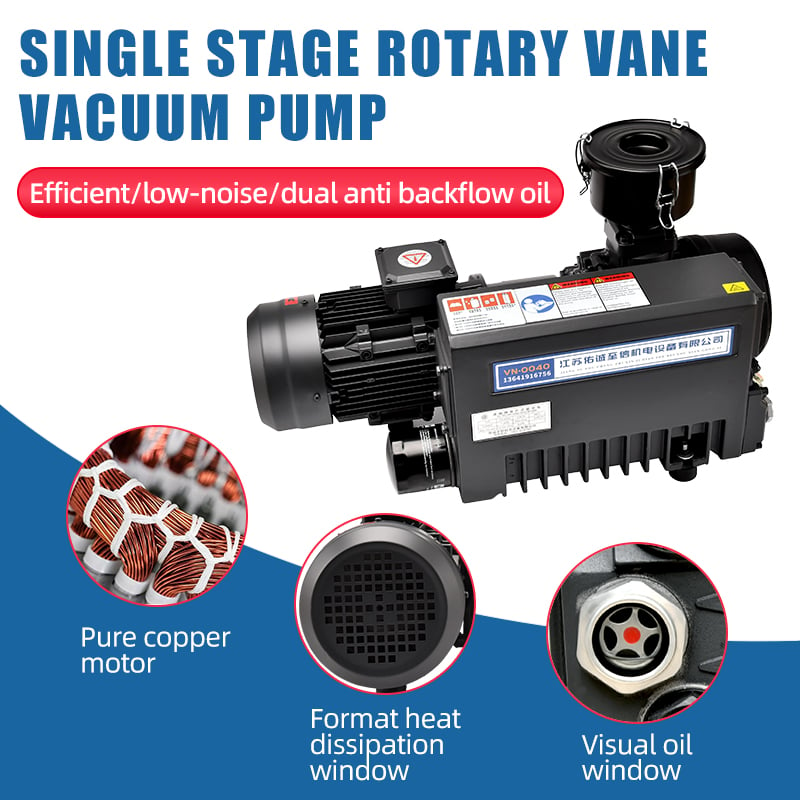
Two rotary vane pumps sit on the same bench, look almost identical and differ by one rotor. One pulls 25 mbar, the other 0.8 Pa. That is not a small step — it is a factor of about three thousand, and it decides whether your process works at all.
This is the difference between a single-stage and a two-stage oil-sealed rotary vane pump, and it is usually the first real decision in a vacuum project.
1. What "two stages" actually means
A single-stage pump has one rotor-and-vane assembly. Gas enters, is compressed once, and leaves through the exhaust valve.
A two-stage pump puts a second, smaller rotor downstream of the first. The first stage does the bulk of the work and discharges into the inlet of the second, which starts from an already-low pressure and compresses again. Two modest compression ratios in series beat one large ratio — which is why the two-stage design reaches pressures a single stage cannot, without needing an exotic mechanism.
2. Read the units before you compare numbers
Most specification sheets mix mbar and Pa, and the two differ by a factor of 100. A pump rated 25 mbar is at 2,500 Pa. A pump rated 0.8 Pa is at 0.008 mbar. Put side by side on one sheet, they look like neighbours; in a chamber, they are not in the same conversation.
So when someone says "the two-stage goes a bit deeper", translate it: 2,500 Pa versus 0.8 Pa, roughly 3,000 times lower.
3. Where a single stage is the right answer
High flow per unit size. Single-stage pumps move a lot of gas for their footprint — that is what most factory vacuum actually needs.
Wet or condensable loads. Vacuum packaging, forming, holding, pick-and-place, vacuum chucking: the pump runs at a shallow working pressure and often sees moisture. A single stage handles this at lower cost and with simpler service.
Continuous duty on a line. Where the requirement is "hold −80 to −95 kPa, all shift", paying for a stage you never use is money in the wrong place.
4. Where a two stage earns its price
Processes that need depth, not volume. Vacuum coating, freeze drying, resin and epoxy degassing, vacuum impregnation, and any step where residual air or vapour at the working pressure spoils the result.
Small chambers with a hard pressure target. A 20-litre chamber pulled to 1 Pa needs very little flow but a great deal of depth — the opposite of what single-stage pumps are built for.
Vapour-heavy duty with a cold trap. Two stages hold deep vacuum better against a light vapour load, provided the condensables are trapped before they reach the oil.
5. Four questions that settle it
6. What changes in service
A two-stage pump carries an extra rotor, an extra set of vanes and a longer oil path. Oil condition matters more, not less: at deep vacuum the oil is doing the sealing, so contamination shows up as lost vacuum long before anything wears out. Budget for oil changes by condition, not by calendar.
A single-stage pump is more forgiving — but it is also the one most often run with a clogged intake filter or a full oil mist separator, which quietly costs flow.
7. The range behind the choice
Both series come from the same workshop at YCZX, which matters more than it sounds: when a project turns out to need the other stage, the change is a model swap rather than a new supplier, a new drawing set and a new lead time. Selection is done against chamber volume, target pressure and vapour load — the three numbers in this article — and pumps ship as bare units or as complete vacuum stations with receivers, as the process requires.
If you are unsure which stage your process needs, send the working pressure, the chamber volume and what is in the gas. That is enough to answer it.

