

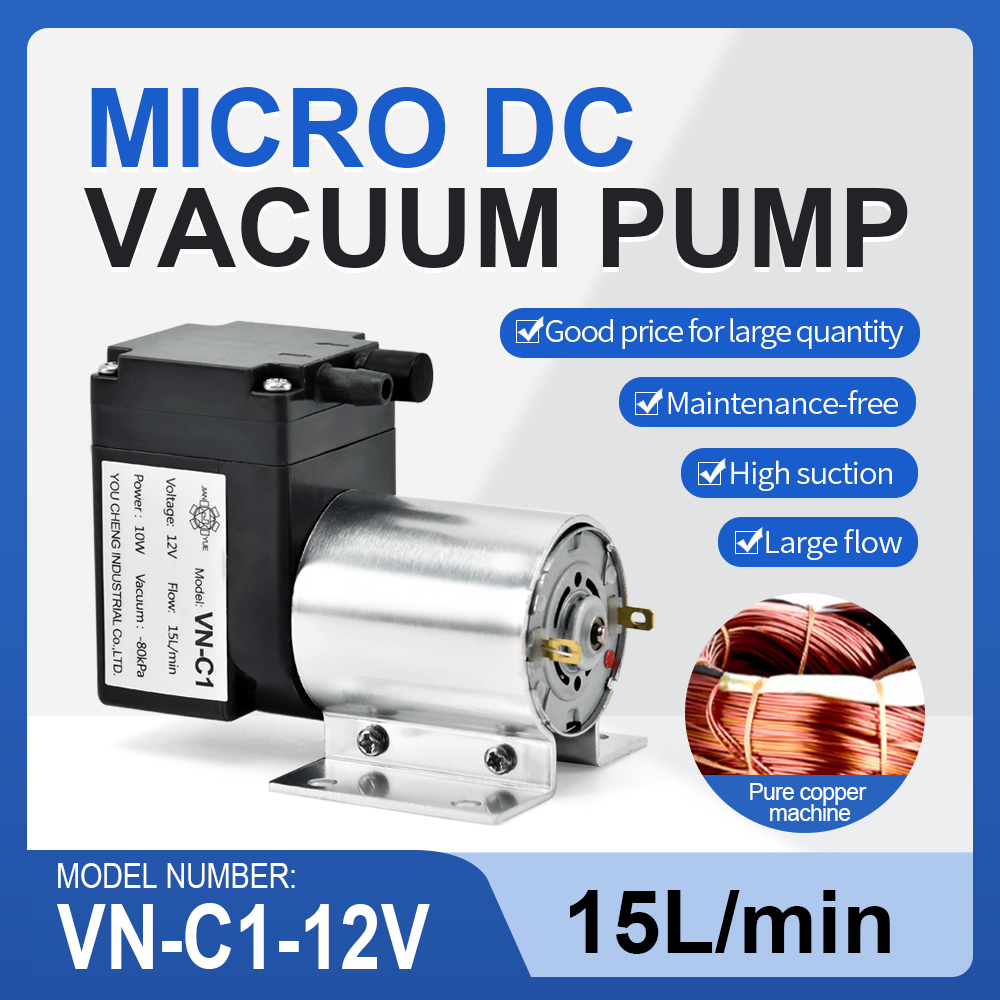
A micro DC vacuum pump is the least glamorous part of a machine and the one that decides whether it feels solid or cheap. YCZX has built them since 2013, in two families: the VN series, single-head, 5–42 W on 12 V or 24 V; and the UV series, which adds a second head and, with it, positive pressure as well as vacuum.
1. Reading the VN-C1 label
Take the VN-C1 — brushless, single head, 12 V.
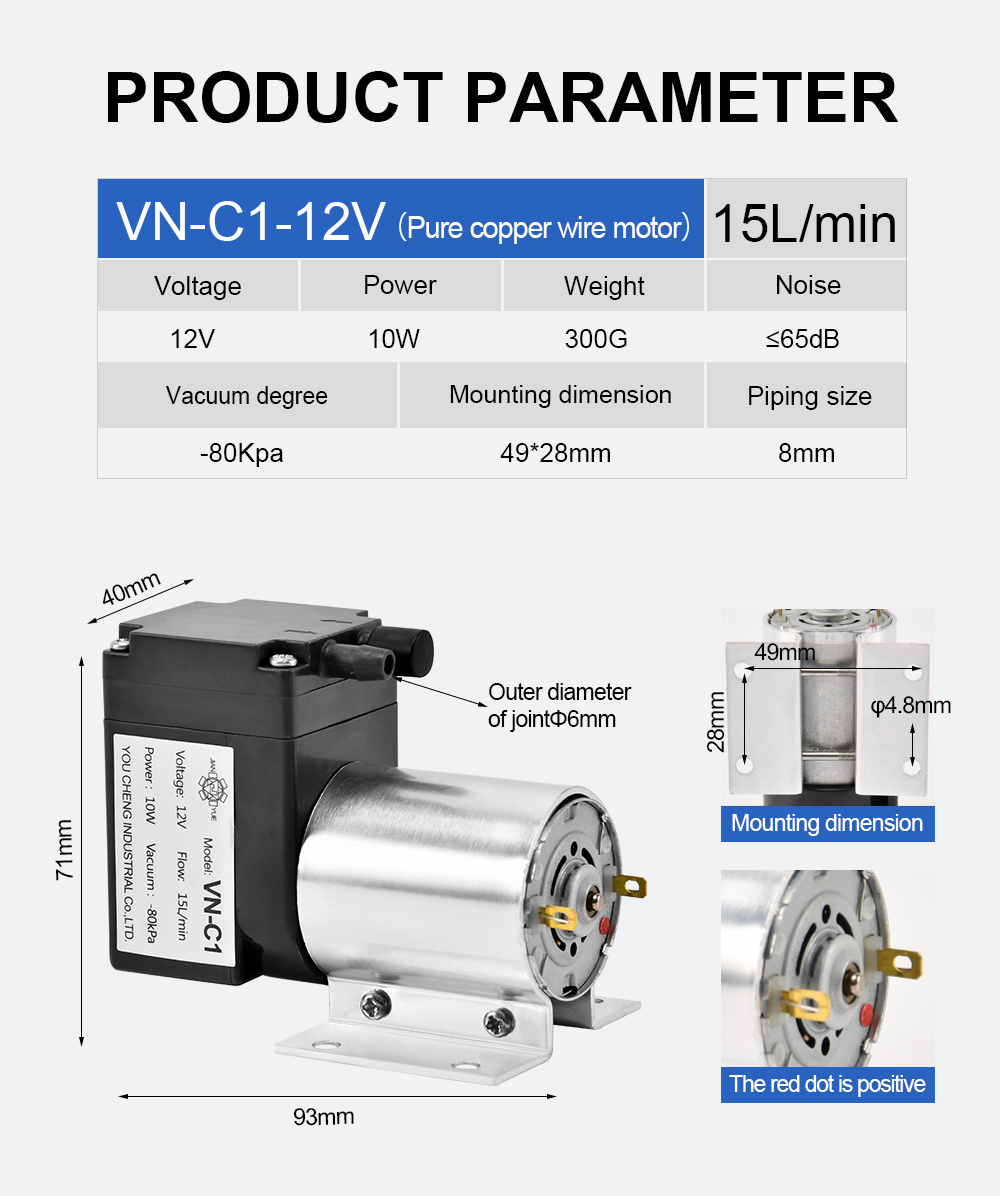
Two of those numbers are routinely misread. 15 L/min is measured at free air; once the inlet is pulled down, flow falls to about a third near maximum vacuum. −80 kPa is a ceiling at zero flow, not a pressure the pump holds while air is being drawn. Neither figure is dishonest — they are simply the two easiest points to measure and the two least useful for sizing.
2. What sits inside every unit
YCZX keeps four details constant across the range.
- A rotor on a full-length shaft. Supported along its whole length rather than cantilevered, so it stays centred at speed — the difference between a hum and a rattle in month eight.
- A steel motor barrel in an engineering-plastic body. Steel carries heat off the windings; plastic forms the pump body and mounting faces.
- Horizontal inlet and exhaust ports, so the tube does not kink at the connection.
- A base that accepts any orientation — upright, on its side, or on a bracket.
The finish is black and silver, sandblasted, with a flying lead.
3. The UV-U3: what a second head buys
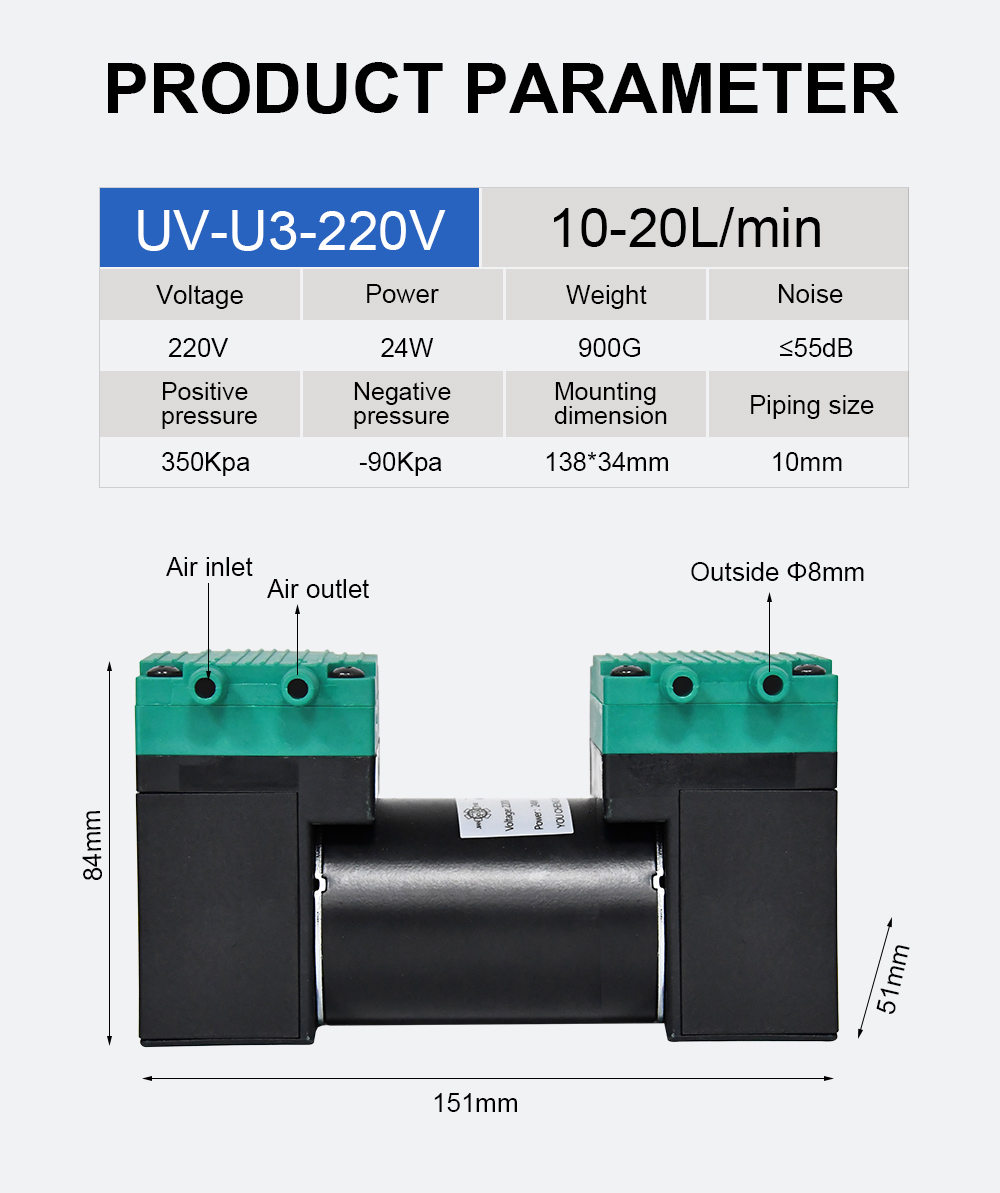
Two heads in parallel roughly double flow without doubling the footprint, and the paired ports let one unit run two suction lines — useful where two small fixtures cycle alternately. The exhaust side gives +350 kPa, enough for a blow-off or a small clamping circuit. The trade is honest: more current, an 850 g body that needs a real bracket.
4. Brushed or brushless, and four installation rules
Brushed is cheaper and fine for intermittent duty — minutes on, minutes off. Brushless changes three things: life (no brushes to wear), electrical noise (no commutator arcing next to sensors), and stability (speed holds as supply and load move).
Four details decide whether the unit survives in the field: match tube to port (6 mm ports take 8 mm OD tube, 8 mm ports take 10 mm OD); red to positive, black to negative; filter the inlet, because diaphragms survive pressure but not grit; and leave the exhaust open, since back pressure quietly cuts flow.
5. When 10 W stops being enough
YCZX builds the station behind the pump as well. The FVN-0063 runs a 500 L receiver, 3 kW, 126 m³/h at −100 kPa, with a PLC touchscreen that rotates two 1.5 kW pumps and starts the second when demand rises. The FSH-5.5 is a cabinet water-ring station: 5.5 kW, 230 m³/h, −97 kPa.
Note the unit jump: micro pumps in L/min, stations in m³/h. 126 m³/h is 2,100 L/min — about 140 VN-C1 units. Nobody buys 140 micro pumps for a line; both ends simply come from the same workshop.
6. Four questions, and who stands behind the answers
Everything above reduces to four questions: what flow the pump gives at your working vacuum, whether the motor suits the duty, whether the port matches the tube, and whether the unit was built to survive the installation. Answer those, and a 10 W pump does its job quietly for years.
YCZX builds both ends of that answer — the VN and UV micro pumps, and the stations behind them — and supplies them to customers in 155 countries. Equipment specified against your duty, and service that continues after the invoice: bought with confidence, run without worry.

