

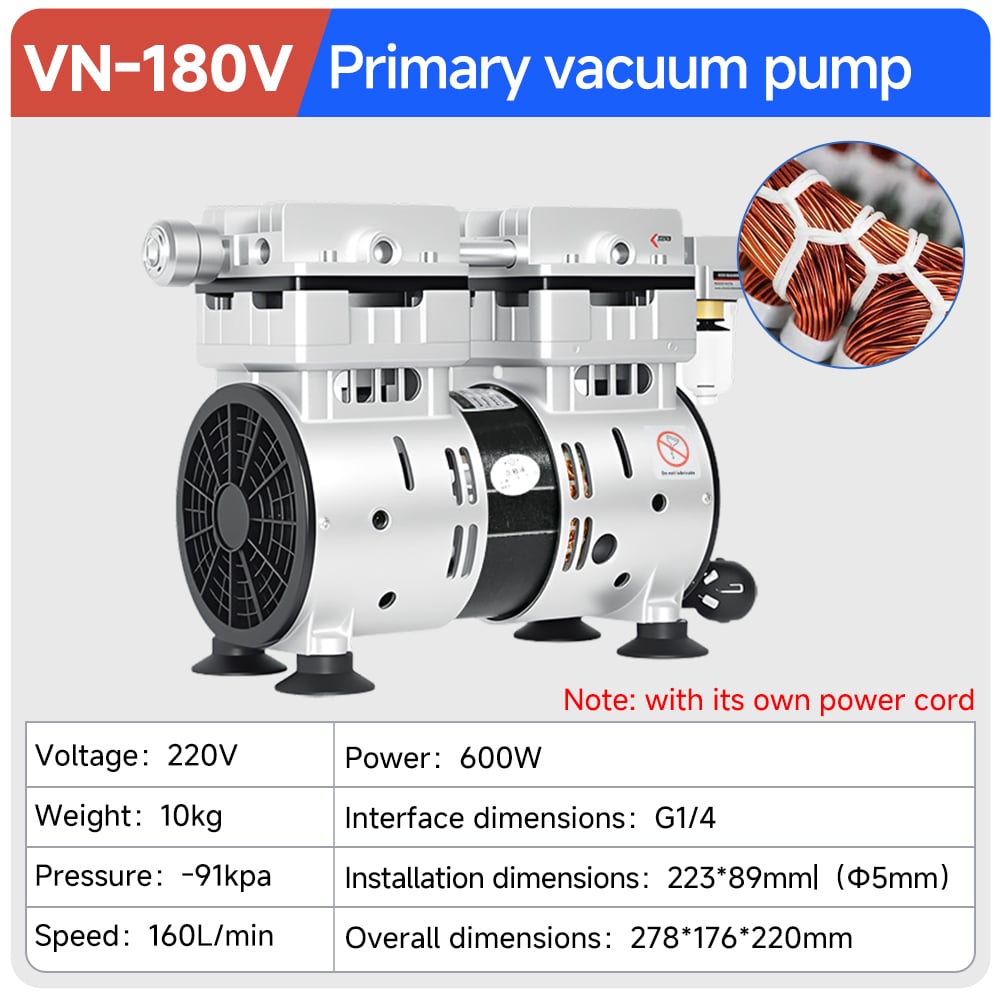
Choosing a vacuum pump is never a one-size-fits-all decision. The same pump that serves a laboratory bench can be entirely inadequate for a production line that runs several machines, and a unit chosen solely on price can under-deliver vacuum, wear prematurely, or contaminate the very workpiece it is meant to handle. Correct selection is the single most effective way to protect both performance and cost over the life of the equipment. This guide sets out the practical method for sizing an oil-free piston vacuum pump, organized around three decisive criteria: flow rate, vacuum level, and duty conditions. By working through these three dimensions in order, an engineer can identify a pump that meets the real requirement without oversizing, and can avoid the field failures that so often trace back to a mismatched choice at the outset.
1. Flow Rate: Size the Pump to the Total Demand
The first and most influential criterion is flow rate, expressed in liters per minute. Flow is the measure of how much gas the pump can move, and it must be matched to the total suction demand of the installation. As a general rule, the more equipment a single pump must serve, and the larger the cavity or chamber it must evacuate, the higher the required flow rate becomes. A small, low-demand station may be served by a modest unit, but a line that cycles several workpieces at once, or evacuates a large chamber, imposes a substantially higher instantaneous demand that only a higher-capacity model can satisfy.
In practice, the total demand is the sum of several components: the swept volume of every suction cup or holding device, multiplied by the frequency with which it is cycled; the volume of any chamber to be evacuated; expected system leakage; and losses in the piping. Sizing too small is the most common error—the pump struggles to establish vacuum quickly, produces weak or slow suction, and runs near its limit, shortening its life. Sizing far too large wastes energy and capital. The target is a pump whose flow comfortably covers the peak demand with a margin for normal leakage.
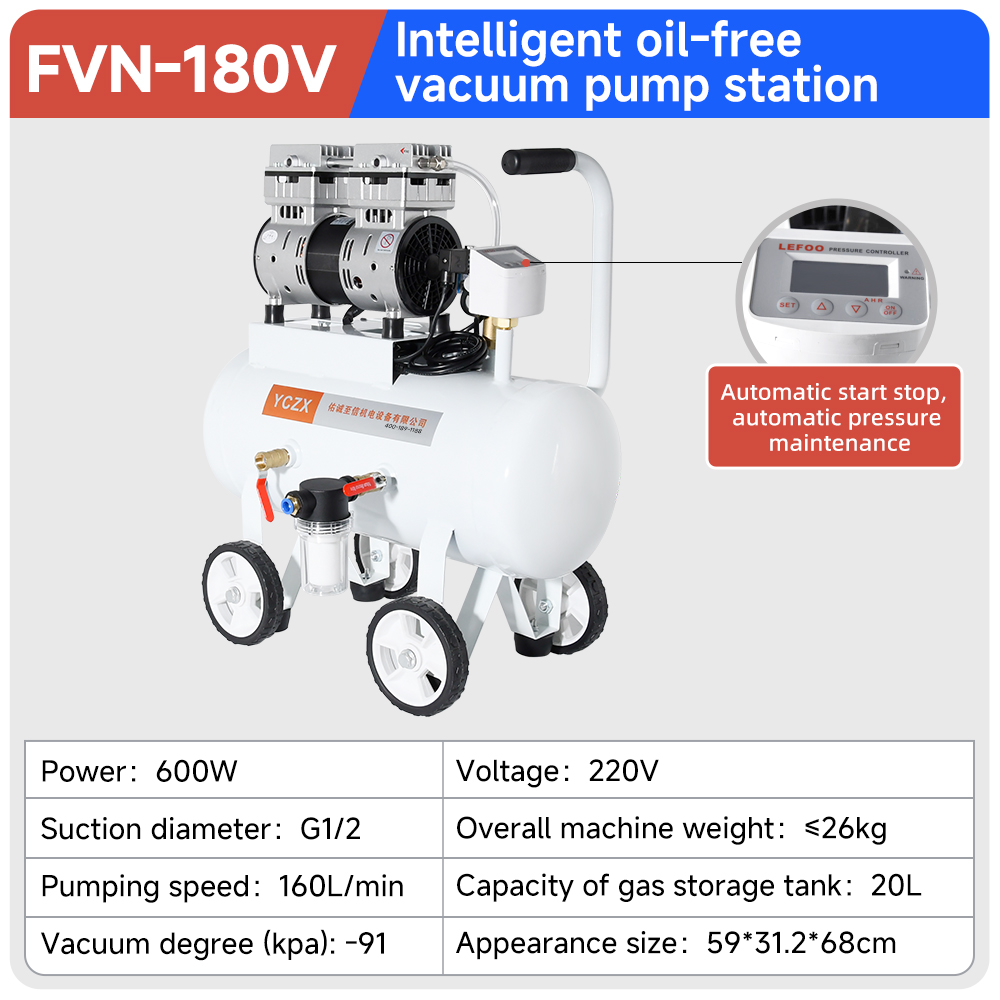
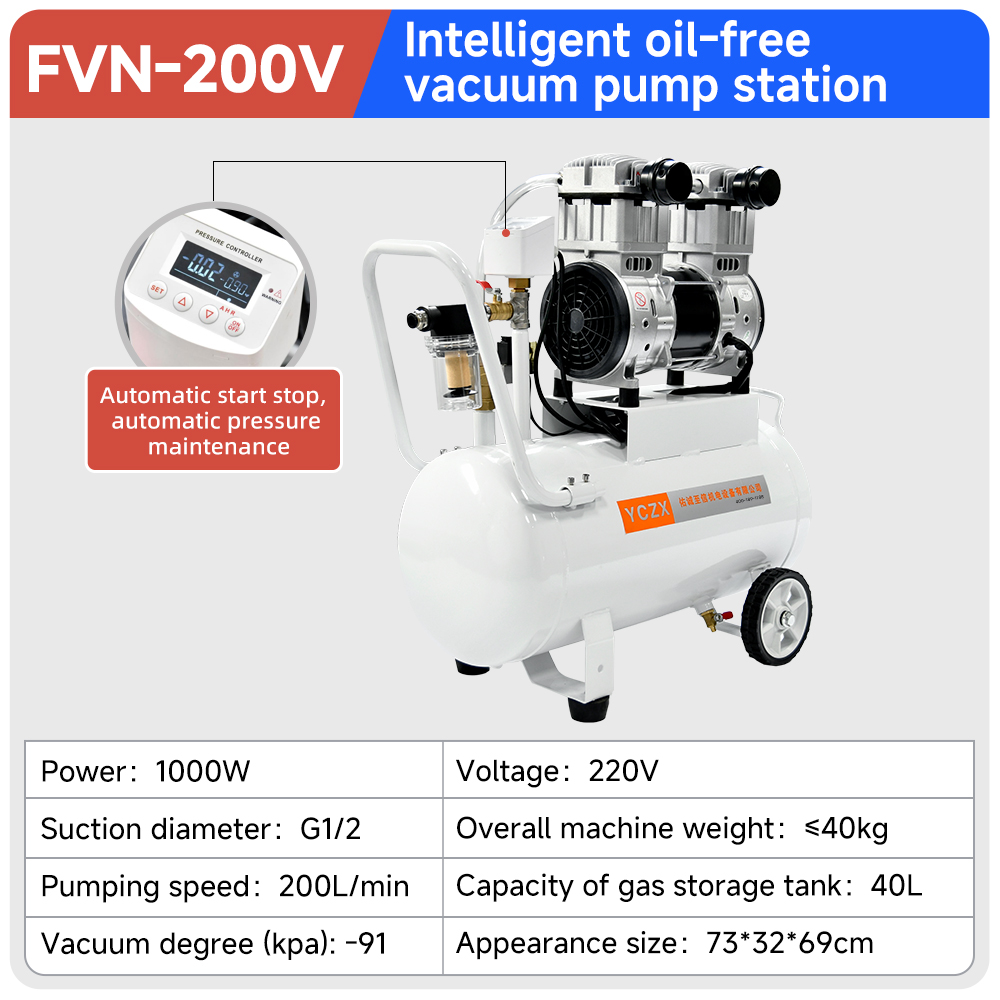
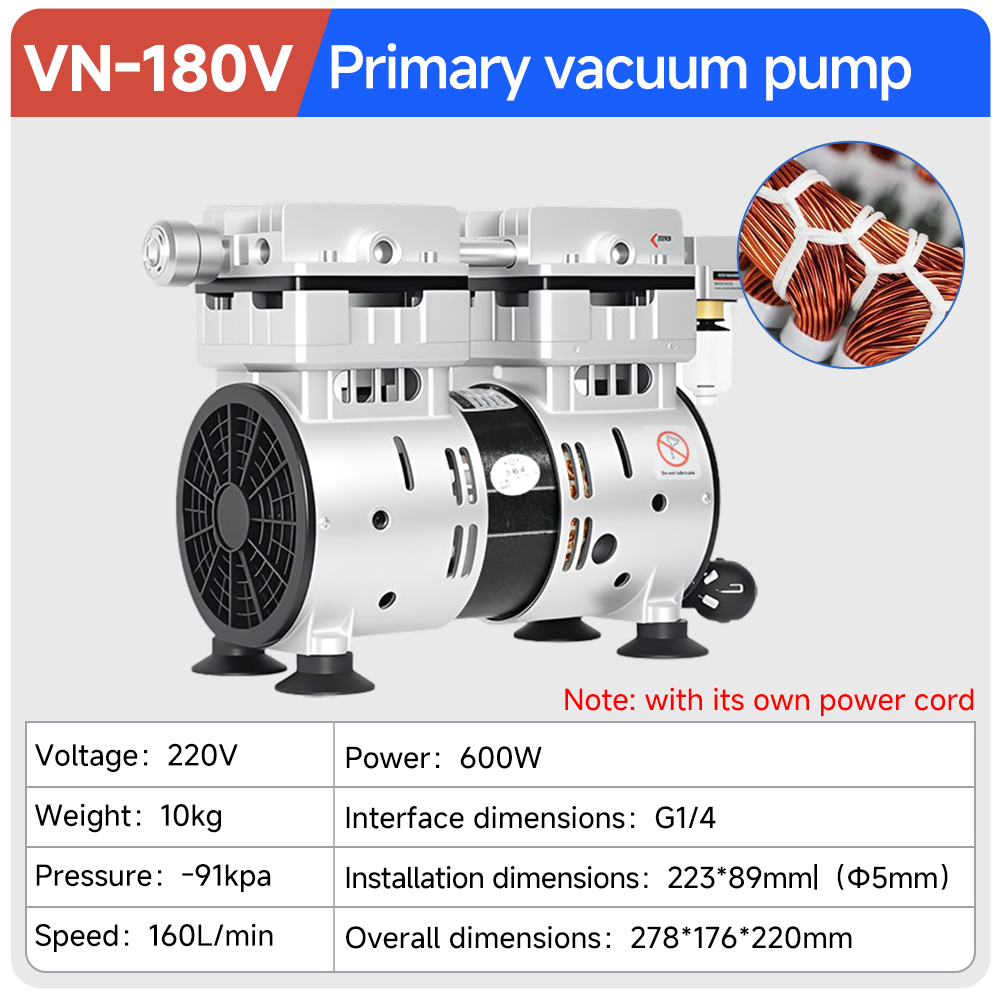
A representative case is conventional CNC machining. Machines of this type commonly use vacuum workholding, chip and dust extraction, and pallet or fixture positioning, each drawing suction during the machining cycle. For a typical CNC machining application, the recommended sizing is an oil-free piston pump of the FVN-180V, 200V, or 300V class and above. A single pump at this level is generally sufficient to drive two to three CNC machines simultaneously, balancing the combined flow demand of the group against the capacity of one unit. This ratio—one pump supporting a small group of machines rather than one per station—is both economical and practical, provided the combined demand does not exceed the pump's rated flow. For larger installations, the same principle scales: add capacity in steps, and verify the total demand against the pump's flow rating rather than relying on rule of thumb alone.
2. Vacuum Level: Choose the Right Operating Profile
The second criterion is the vacuum level the process actually requires, and here the model suffix carries real meaning. Oil-free piston pumps are offered with distinct operating profiles, typically distinguished by a suffix that signals the trade-off between pumping speed and ultimate vacuum.
Models with a "V" suffix are oriented toward high evacuation speed and high flow rate. They are designed for applications in which the priority is to pull vacuum quickly and to move a large volume of gas, rather than to reach the deepest possible negative pressure. This profile suits fast gripping, continuous feeding, and other high-cycle operations in which the vacuum must be re-established promptly at every cycle. If the dominant need is speed of response and throughput, a V-class unit is the appropriate choice.
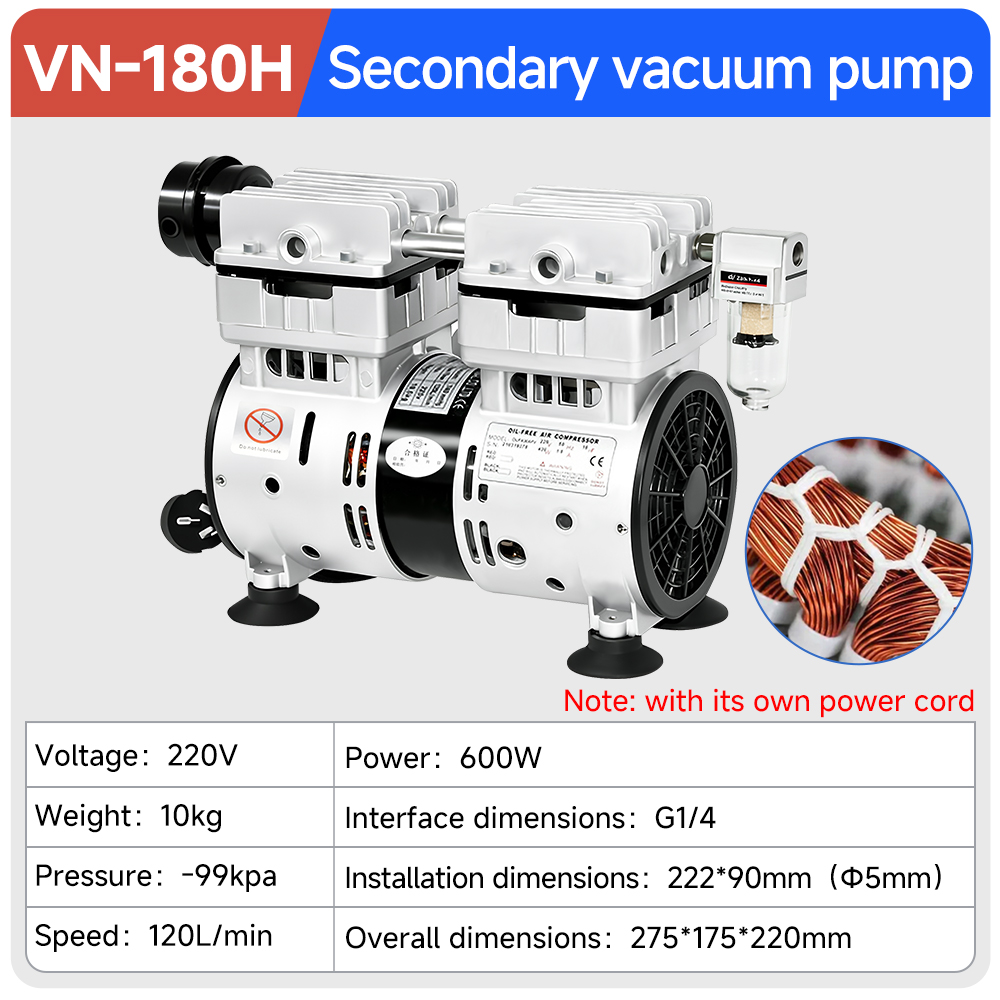
Models with an "H" suffix are oriented toward deeper negative pressure. They are built to hold a lower residual pressure and are intended for processes that depend on the depth of vacuum rather than on raw flow. Typical duties include degassing of closed containers, filtration under suction, and negative-pressure hold in sealed chambers. For such applications, the ability to reach and sustain a lower absolute pressure is what matters, and an H-class unit is selected accordingly.
It is worth stating explicitly that evacuation speed and ultimate vacuum are generally in tension: a pump optimized for rapid gas movement will not necessarily reach the deepest vacuum, and a pump optimized for deep vacuum may move less gas. The correct choice therefore depends on which characteristic the process demands. Where the cycle is fast and continuous, prioritize flow and select a V-class unit; where the process is a sealed, static hold that needs low residual pressure, prioritize ultimate vacuum and select an H-class unit. Matching the suffix to the dominant requirement is a simple but powerful step that prevents both sluggish cycles and unattained vacuum targets.
3. Duty Conditions: Fit the Pump to the Environment
The third criterion is the operating environment and the constraints it places on the pump. Four conditions in particular define whether an oil-free piston pump is the right technology, and they should be checked against the application before any purchase.
Cleanliness of the exhaust comes first. Where the process cannot tolerate oil contamination of the workpiece or the sample, an oil-free pump is effectively mandatory. Its dry construction ensures that no oil mist enters the gas path, protecting sensitive products, workpieces, and laboratory samples from contamination. If the application is clean-critical in this way, the oil-free architecture is a decisive advantage rather than an option.
Maintenance burden is the second condition. An oil-free piston pump eliminates the periodic oil-change cycle and the associated upkeep of a lubricated machine. Where the operator wants simple, low-intervention maintenance, the dry design delivers it directly. This is especially valuable in decentralized installations where a maintenance team is not always on site.
Space and mounting constraints are the third condition. Many modern installations require the pump to be embedded within a machine or mounted on a bench, leaving little room for a large, standalone unit. The compact footprint of an oil-free piston pump suits exactly this kind of installation—small enough to fit inside a frame or on a work surface while still delivering adequate capacity. If the layout demands a compact, integrable unit, the oil-free form factor is the natural fit.
Budget and noise considerations round out the set. Where capital cost must be kept low and noise and vibration levels are restricted—in a workshop, laboratory, or shared workspace—the oil-free piston pump offers a favorable combination: lower acquisition cost, quiet operation, and low vibration. These characteristics align with applications that need a clean, affordable, unobtrusive vacuum source rather than the heavy-duty endurance of a large industrial unit.
Correct pump selection is a matter of method, not intuition. Work through the three dimensions in order: size the flow rate to the total demand of the installation, allowing for equipment count, chamber volume, and leakage; choose the operating profile—high-speed "V" class or deep-vacuum "H" class—according to whether the process needs rapid evacuation or low residual pressure; and verify that the duty conditions—cleanliness, maintenance burden, mounting space, and budget—are met by the oil-free architecture. Done in this order, the process reliably yields a pump that performs as required, costs no more than it must, and serves the line for years. As you plan your next installation, YCZX offers a graduated range of oil-free piston vacuum pumps across these flow, vacuum, and duty profiles, supported by application guidance to help you size the right unit for your specific process. Choose the pump that fits the duty, and the duty will reward you with consistent, dependable vacuum.

