

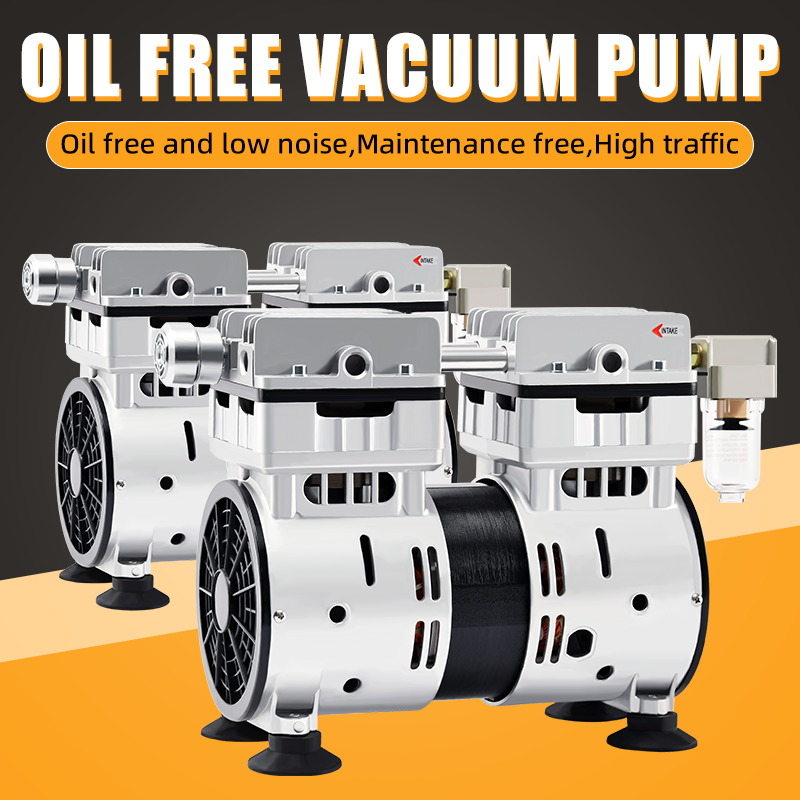
An oil-free piston vacuum pump is a precision mechanical device, and its service life and vacuum performance depend as much on how it is installed and operated as on its inherent design. Even a correctly selected unit can suffer premature wear, internal damage, or a sudden loss of suction if it is mounted improperly, fed contaminated gas, overloaded without storage capacity, or denied adequate cooling. The purpose of these guidelines is to translate the care that a dry-running piston pump requires into a clear, practical set of installation and operating rules. They cover intake filtration, leveling and mounting, storage capacity for continuous duty, prohibited media, and ventilation and cooling. Following these five points protects the piston seals and motor, stabilizes the delivered vacuum, and extends the pump's working life, while ignoring them tends to produce the exact failures the pump was otherwise engineered to avoid.
1. Install an Intake Vacuum Filter to Protect the Pump Internals
The first and most essential installation measure is to fit a vacuum filter at the intake of the pump. Because an oil-free piston pump has no oil film to trap and flush away incoming particles, any dust, fine debris, or solid fragment drawn into the compression chamber reaches the sliding piston and seal surfaces directly. Abrasive particles score the cup seal and cylinder liner, open leakage paths, and gradually reduce both sealing performance and pumping capacity. Once the internal surfaces are scored, the damage is mechanical and largely irreversible; the pump must then be opened and repaired rather than serviced through routine adjustment.
The vacuum filter acts as the first line of defense, intercepting dust and fragments before they enter the pump body. It should be installed as close to the intake port as practical, with clean, short piping between the filter and the pump, and selected for the required flow so that it does not itself become a flow restriction. The filter element should be inspected and replaced on a regular schedule: a clogged filter raises intake resistance, lowers the achievable vacuum, and forces the pump to work harder than necessary. In dusty environments—such as machining, packaging, or general workshop extraction—more frequent inspection is warranted. This single measure is the most cost-effective step an operator can take to avoid piston wear and to preserve the pump's rated service life.
2. Keep the Pump Level, Stable, and Free of Stacked Load
The second guideline concerns mechanical mounting. The pump body must be placed on a level surface, with its mounting feet resting firmly and steadily on the ground or support. A level installation keeps the piston, seal, and bearing loads aligned as designed; a tilted or uneven base introduces side loading on the moving parts, accelerates wear, and can produce vibration and noise that a level mount would not generate. The feet should make full contact with the supporting surface, and the unit should sit solidly rather than rocking on one or two points.
A second, equally important rule is that heavy loads must not be stacked on top of the pump. The housing and motor are engineered to support the internal mechanism, not to carry external weight. Placing tools, components, or other equipment on the pump can deform the housing, misalign the motor and piston, obstruct ventilation openings, and transfer vibration between units. The pump should stand on its own dedicated support, with clear space around it, and any piping connected to it should be secured so that its weight and tension do not hang on the pump's ports. Proper leveling and load relief are quiet, preventive measures that pay off in lower vibration, quieter running, and longer bearing and seal life.
3. Pair a Receiver Tank for Long Continuous Duty
The third guideline addresses operation under long, continuous cycles. For installations that run around the clock—24-hour continuous duty—a small negative-pressure storage tank, or pressure reservoir, is recommended alongside the pump. Without storage capacity, the pump must start and stop repeatedly to maintain the set vacuum in the system. Each cycle imposes a starting current surge on the motor, mechanical stress on the piston and seals, and repeated thermal transitions on the internal components. Frequent start-stop cycling is one of the principal drivers of accelerated wear in a dry piston pump, because the seals and motor are not given a stable thermal state in which to run.
The reservoir tank changes this behavior. It stores a reserve of negative pressure so that the pump runs in longer, more stable intervals and switches off while the stored vacuum serves the demand. The number of start-stop events drops sharply, reducing electrical stress on the motor, mechanical fatigue on the seals, and overall energy consumption. The delivered vacuum at the point of use also becomes more stable, because the reservoir absorbs short, fluctuating demands that would otherwise make the pump hunt between its pressure thresholds. Sizing the tank to the system's consumption and leakage is a straightforward exercise: a larger reservoir extends each running interval, while an undersized one offers little relief. For any long-running installation, this pairing should be considered a normal part of the system design rather than an optional accessory.
4. Never Draw in Water or Strongly Corrosive Gases
The fourth guideline is a hard prohibition rather than a recommendation: water and strongly corrosive gases must never be drawn directly into the pump. The internal piston seal assembly and the motor are built for clean, dry air, and contact with liquid water or aggressive chemical vapor causes direct, rapid damage. Liquid entering the compression chamber washes away the self-lubricating properties of the seal, swells or embrittles sealing materials, and can hydraulically shock the piston; corrosive gases attack the seal compounds, metal surfaces, and motor windings, leading to seal failure, rust, insulation breakdown, and in severe cases motor burnout.
Where the process gas may contain moisture, condensation, or chemical fumes, the correct response is not to run the pump without protection, but to condition the gas before it reaches the pump—through a moisture separator, condensate trap, or appropriate filtration and neutralization stage—and to verify that the pump's materials of construction are compatible with the medium. If the application inherently handles wet or corrosive gas, a purpose-built wet or chemical-resistant pump should be selected instead. Keeping water and corrosive media out of the dry piston chamber is a non-negotiable protection step; once these substances enter the internal assembly, the resulting damage can be severe enough to require replacement of the seal set or the motor itself.
5. Maintain Cooling Clearance and Schedule Cooling Breaks
The fifth and final guideline concerns heat dissipation. A running vacuum pump generates heat through motor winding losses and friction in the piston seals, and that heat must be carried away to the surrounding air. The pump should therefore be positioned with more than 30 centimeters of free space on every side, so that air can circulate around the body, motor, and cooling fins without obstruction. Enclosing the unit in a cabinet without ventilation, crowding it against a wall or machine, or stacking equipment around it traps heat, raises operating temperature, accelerates seal aging, and can trip motor overload protection. Adequate clearance is the simplest way to keep the pump within its designed thermal range.
Beyond ambient clearance, continuous operation should respect the pump's thermal limits. When a single pump head runs uninterrupted for more than roughly four to six hours, a cooling break of about fifteen minutes is recommended to allow the internal temperature to stabilize and the seals and motor to cool before the next run. This practice is particularly relevant for installations that lack the reservoir arrangement described earlier; where continuous cycling is unavoidable, scheduled breaks give the mechanical and electrical components time to dissipate accumulated heat. Overheating is a gradual failure mode: it dries and hardens the seals, weakens motor insulation, and reduces suction over time, all of which become apparent only after prolonged abuse. Managing both clearance and operating intervals therefore preserves stable performance and prolongs the working life of the unit.
Conclusion
Reliable vacuum performance in an oil-free piston pump is a combination of good engineering at selection and disciplined care in installation and use. Install an intake filter to keep abrasive particles out of the sliding internals; keep the pump level, stable, and free of stacked load; pair a reservoir tank for 24-hour continuous duty to reduce start-stop cycling; keep water and strongly corrosive gases out of the compression chamber at all times; and preserve more than 30 centimeters of cooling clearance while scheduling short cooling breaks during extended operation. Followed together, these practices protect the piston seals and motor, stabilize the delivered vacuum, and materially extend service life. YCZX supplies a range of oil-free piston vacuum pumps together with matching intake filters, reservoir tanks, and installation guidance, so that each installation is set up for clean, quiet, and dependable long-term operation. When the pump is installed and operated according to these guidelines, it delivers the consistent, contamination-free negative pressure the process was designed to rely on.

