

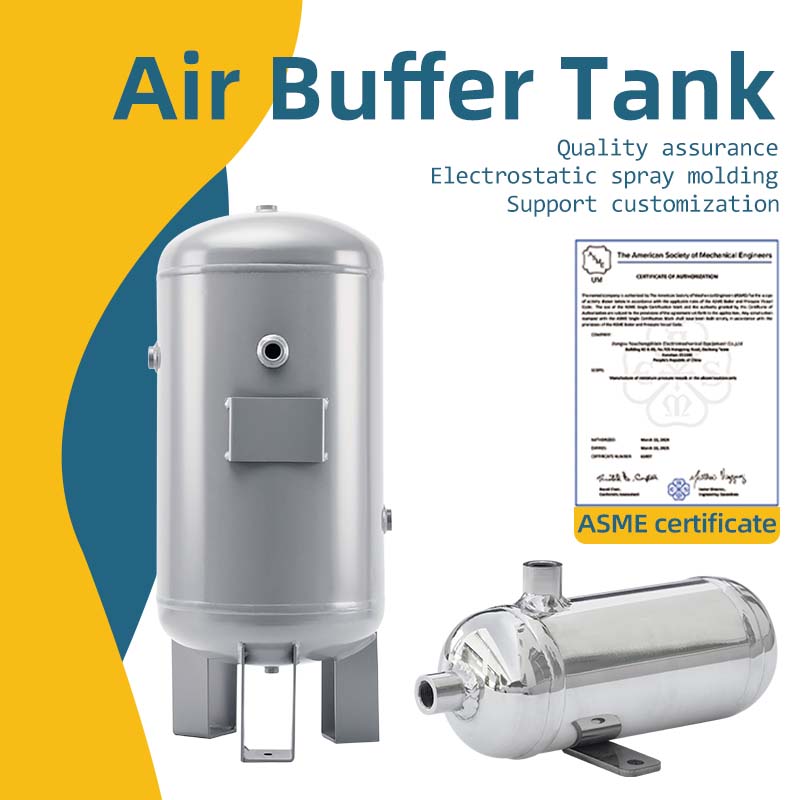
For most industrial standard air receivers, customers frequently raise a fundamental question: can a regular compressed‑air storage tank withstand not only positive internal pressure but also negative‑pressure (vacuum) working conditions? The straightforward answer is: general‑purpose positive‑pressure air receivers are NOT automatically suitable for vacuum service. Though the same steel shell holds pressure when internal pressure is higher than ambient atmosphere, its structural behaviour changes completely under negative‑pressure vacuum conditions. Many end‑users mistakenly assume that if a tank passes hydrostatic positive‑pressure testing, it can safely work under vacuum. This dangerous misunderstanding may lead to catastrophic shell buckling, inward collapse and permanent tank failure in field operation. YCZX’s engineering team encounters this design pitfall repeatedly during custom‑vessel technical reviews.
Positive‑pressure loading and negative‑pressure loading place totally different mechanical demands on pressure‑vessel geometry. Under positive internal pressure, the wall of an air receiver mainly bears membrane tensile stress. Internal force pushes the cylinder shell and dished heads outward, stretching steel material. Common carbon‑steel tanks built per GB150 or ASME Section VIII Div.1 positive‑pressure rules are engineered to resist this tensile force. Hydrostatic pressure testing verifies tensile strength and joint tightness under elevated positive water pressure.
Vacuum / negative‑pressure service applies external atmospheric compressive load onto the tank wall. When inside pressure drops below outside atmospheric pressure, atmospheric pressure squeezes inward on every surface of the vessel. Instead of being stretched, the shell, heads and support structures are subject to compressive stress. Thin‑walled cylindrical shells are inherently weak against compression instability. Even steel that has plenty of tensile strength may suffer elastic buckling: sudden inward denting or total collapse without material tearing. Buckling is a stability‑driven failure mode, not a material‑strength‑driven failure. A tank may pass a high‑pressure hydrostatic test perfectly yet crumple at a relatively mild vacuum level.
Multiple design variables determine vacuum‑resistance capacity: shell wall thickness, diameter‑to‑thickness ratio, head form, internal reinforcing rings, external stiffeners, allowable vacuum degree and operating cycle. Standard positive‑pressure air receivers are sized only for internal tensile loads. Their wall thickness is often far too thin for vacuum stability. Simply making a standard positive‑pressure tank and blocking all outlet ports while evacuating air will create severe safety risks. Even partial vacuum can produce local buckling on cylindrical sections or dished heads.
There are real‑world scenarios where custom vessels must cope with mixed conditions: alternating positive‑pressure cycles and occasional negative‑pressure events. For example, tanks connected to vacuum pumps, certain buffer‑storage circuits, or systems where rapid cooling creates transient internal vacuum. For these mixed‑service applications, two engineering solutions exist.
First solution: special vacuum‑rated custom design. YCZX can engineer vacuum‑compatible pressure vessels. Our engineers increase wall thickness appropriately, or design internal stiffening rings, select vacuum‑qualified dished heads, and perform formal external‑pressure stability calculation according to pressure‑vessel codes. The finished unit must go through dedicated external‑pressure assessment beyond routine hydrostatic positive‑pressure testing. It is worth emphasizing: conventional hydrostatic testing cannot validate vacuum stability; special calculation and evaluation are mandatory.
Second solution: add reliable protective measures on system level. If the customer still wishes to use a regular positive‑pressure air receiver, strict system safeguards must be installed to physically prevent negative‑pressure from developing inside the tank. Typical hardware includes anti‑vacuum breakers (vacuum‑relief valves). This safety valve opens automatically and draws in ambient air the moment slight negative‑pressure appears inside the tank. It breaks vacuum and keeps internal pressure always above atmospheric level, protecting the tank shell from buckling damage. However, installing a vacuum‑relief valve is a system‑level protection measure; it does not turn the original positive‑pressure‑only tank into a genuine vacuum‑pressure‑rated vessel. The whole system layout, valve sizing and installation location must be reviewed by technical professionals.
In daily custom‑project communication, YCZX reminds clients of typical mis‑application cases. Some customers purchase ordinary compressed‑air receivers for vacuum buffer use, judging safety solely by the marked positive working pressure. Once transient vacuum emerges during equipment shutdown or rapid gas cooling, the tank suffers inward buckling. Such damage is non‑repairable and requires complete tank replacement. In serious cases, deformed tank fragments threaten personnel safety.
It is also important to note that welding quality, roundness of cylinder shell and out‑of‑roundness of dished heads exert greater influence for vacuum‑service vessels. Minor ovality or local dimples, which are harmless under positive‑pressure conditions, become buckling initiation points under external compression. That is why vacuum‑grade custom vessels demand tighter forming tolerance during plate rolling, assembly and welding. Our full‑process standardized manufacturing workflow controls shell roundness, weld quality and dimensional deviation, meeting stricter geometric requirements for external‑pressure vessels.
To summarise:
- Ordinary commercial air receivers are designed for positive‑pressure compressed‑air service. They are not rated for vacuum / negative‑pressure operation by default. Passing hydrostatic positive‑pressure test cannot prove vacuum‑resistance performance.
- Negative‑pressure (vacuum) brings compressive‑instability buckling risk, a completely different failure mechanism compared to positive‑pressure tensile rupture or leakage.
- If your system requires vacuum‑bearing capability, inform our engineering team in advance for custom external‑pressure calculation and special design. Alternatively, integrate properly‑specified vacuum‑relief‑valve protection to eliminate negative‑pressure occurrence inside standard tanks.
Many procurement teams focus only on marked working pressure stamped on nameplates, overlooking whether the vessel is qualified for external‑pressure vacuum scenarios. Mis‑selection may cause costly equipment failure and safety hazards.
When you source custom‑built pressure‑vessel air receivers, partner with a manufacturer who understands both positive‑pressure and vacuum‑related design risks. YCZX’s technical team reviews every project’s full operating‑condition envelope: maximum positive pressure, possible transient vacuum events, temperature range and medium properties. We provide targeted engineering suggestions, whether you need standard positive‑pressure air receivers, custom vacuum‑rated vessels, or advice on system‑level anti‑vacuum protective components.
Choose YCZX for your next custom‑pressure‑vessel project. We help you avoid hidden design‑selection pitfalls and deliver code‑compliant, safe air receivers matched precisely against your real‑world operating conditions.

