

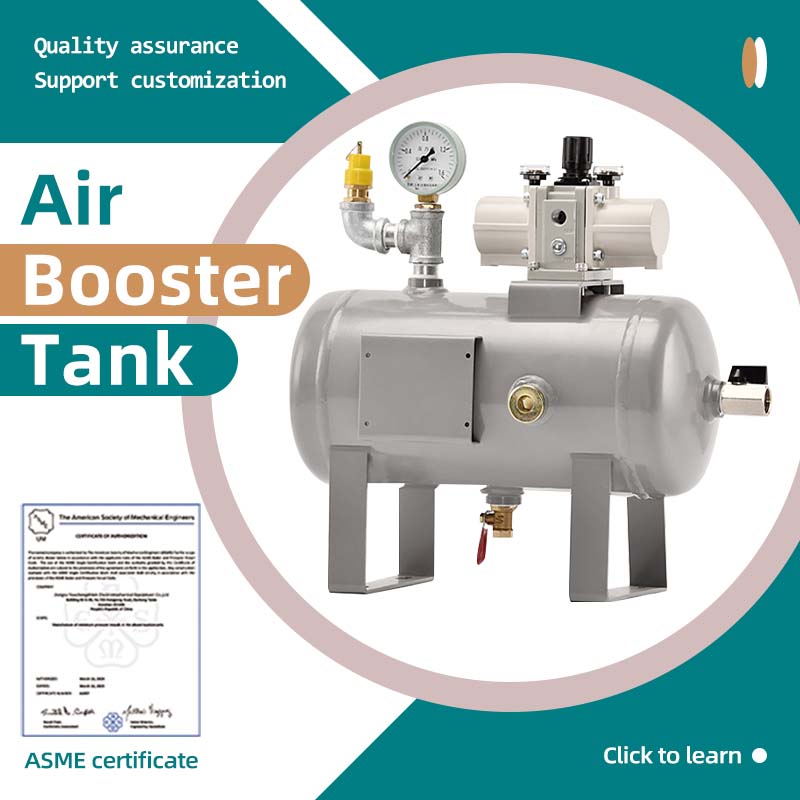
A VBA booster valve takes the 0.4–0.8 MPa air a factory already has and returns roughly twice that pressure at the outlet — no motor, no wiring, no heat. It is a simple promise, and most of the buying decisions around it go wrong for reasons that have nothing to do with the valve itself.
1. What the valve actually does
The VBA series is a 2:1 pneumatic booster. Plant air enters at 0.4–0.8 MPa; the outlet delivers about double that, driven entirely by the air itself. Nothing electrical sits in the loop, which matters on a shop floor where adding a socket is a project.
Two consequences follow: the valve can only double what you feed it — 0.5 MPa in means about 1 MPa out — and because the gas is also the drive, it must be clean and dry.
2. Five parts, and what each means when you buy
Every VBA valve contains the same five groups — which is what lets a buyer check a quotation rather than accept it.
The piston pair. A single piston rod carries a drive piston and a boost piston with a strict 2:1 area ratio — that ratio is the gain. Wear-resistant polyurethane O-rings — the spec YCZX uses on both pistons — seal each end and keep the high and low pressure chambers apart. When a unit eventually loses performance, this is the part that has worn, so ask whether a seal kit is available.
The reversing valve. A spool at the top of the body switches the inlet direction using the pressure difference between the two ends, so the piston keeps cycling without any external pilot. No solenoid, no timer.
The regulating mechanism. A top knob loads a spring and diaphragm. Once outlet pressure reaches the setting, the valve balances and stops boosting — that is why the unit holds a setpoint instead of climbing until something bursts.
Two check valves. The inlet check keeps boosted air from flowing back into the plant network; the outlet check holds pressure in the downstream line while the piston returns. Both are cheap parts doing expensive work: without them, every return stroke would bleed the receiver.
Three chambers. Drive chamber (plant air), boost chamber (the doubled pressure), and exhaust chamber, which vents surplus air through a silenced port in the body. If a valve is noisier than expected, that port is usually where the sound comes from.
3. The receiver is not an accessory
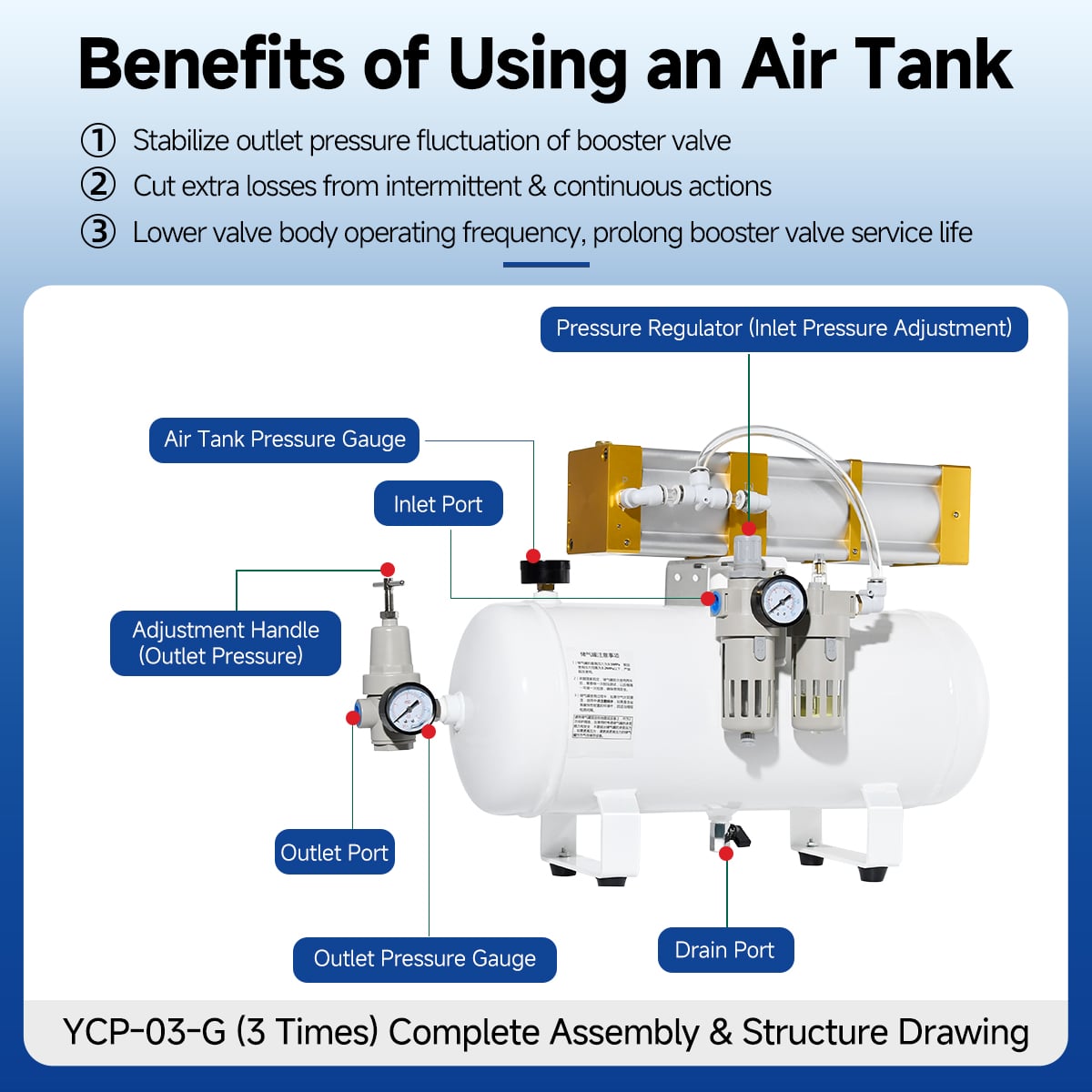
A booster valve delivers in pulses. Without storage the line sees that pulse and a sag on every actuation. With a receiver in the loop:
the outlet pressure ripple is smoothed, so fixtures and test benches see a steady number;
air loss from intermittent and continuous actuation drops, because the tank carries the peaks instead of the valve chasing them.
That is the commercial argument for buying them together: the valve sets the pressure, the tank makes it usable. YCZX supplies both ends of that sentence from the same workshop, so the two are matched before they reach the pallet.
4. Plumbing it correctly
The order of the connections matters more than the brand of the fittings.
Air treatment first. Run the plant air through a filter-regulator (FRL) before it reaches the valve. Water and oil carry-over is the fastest way to destroy the piston seals, and no warranty covers a wet supply.
IN gets low pressure, OUT gets boosted pressure. The body carries two gauge ports for exactly this reason: the left gauge reads incoming pressure, the right one reads what you are actually delivering.
Feed the receiver from the outlet. When the valve is mounted on a tank, the outlet port connects to the tank inlet; the tank itself needs a safety valve port, a drain at the lowest point, and at least one spare port for the gauge or a test point.
Plug what you do not use. Taking air from the receiver's bottom outlet means plugging the front OUT port, or the boosted air escapes before it reaches the line.
5. Commissioning in three steps
Open the supply at 0.4–0.8 MPa — the routine that ships with every YCZX valve — turn the knob slowly — clockwise up, counter-clockwise down — watch both gauges, stop at what the machine actually needs, then lock the knob against vibration. The valve cycles to setpoint, goes quiet, restarts when pressure falls. Depressurise the receiver before anyone opens a fitting.
6. Checking what arrives
Most buyers skip this and find the problem at commissioning. Four checks, twenty minutes.
Nameplate against the order. Ratio and pressure ranges, line by line — a 2:1 and a 5:1 body look alike on a bench.
Ratio against two gauges. Feed a known inlet, read the outlet. A healthy unit lands near double; a tired one lands well under.
Leak-down. Reach setpoint, close the supply, watch the gauge for ten minutes. A steady fall points at a check valve or piston seal — easier to raise now than after installation.
Vessel plate. Maximum allowable pressure must cover the boosted value, the relief valve must be set at or below it, and the CE/PED, ASME or DOSH certificate should arrive with the goods.
7. What wears, and what keeps it running
A booster has no motor to burn out — only seals that flex every cycle and two check valves that see whatever the air carries.
The piston seals go first, politely: the valve cycles more often, then stops holding its setpoint. A seal kit on the shelf turns that into an hour of work instead of a fortnight of waiting. The check valves fail quietly, letting pressure creep back into the plant line or the outlet sag between strokes; upstream filtration is what prevents it.
The rest is routine — relief valve and gauges checked yearly, receiver drained on a fixed schedule, water carry-over treated as the enemy it is.
8. Why the details decide the outcome
A booster valve is a small purchase sitting upstream of an expensive process. The ratio is fixed by geometry, the wear is predictable, and most failures trace back to something upstream — wet air, a tank rated for the wrong pressure, a setpoint nobody recorded.
That is the part Jiangsu Youcheng Zhixin takes responsibility for: valve and receiver are configured as one system, the vessel is rated against the boosted pressure rather than the plant line, and the commissioning steps we hand over are the ones we would follow ourselves. A buyer who compares on that basis usually ends up with a system that behaves the same in year three as it did in week one.

