

1. Pneumatic System Characteristics of Automatic Packaging Equipment
Automatic packaging machinery heavily depends on compressed air to drive a wide range of actions: bag opening, material filling, sealing, cutting, labeling, conveying and cylinder‑driven clamping.
Most packaging lines feature frequent, short‑burst air consumption. Multiple stations act in quick succession at high‑speed operation. Instant air flow surges occur every fraction of a second. Even minor pressure fluctuation will bring visible impact on finished‑product quality. Unlike equipment with stable continuous air demand, packaging machines require fast air response and steady pressure to guarantee consistent packaging precision and line throughput.
2. Why Air Receiver Tanks Matter for Packaging Production Lines
An appropriately sized air tank serves as energy storage and pressure buffer between air compressors and packaging machines.
It releases stored compressed air instantly when multiple pneumatic cylinders trigger at the same moment, offsetting instantaneous flow demand and preventing sharp pressure drop across the pipeline. Stable pressure ensures uniform sealing force, reliable bag‑gripping action and accurate cutting position. Meanwhile, condensation and partial oil mist settle inside the tank, lowering the workload of downstream filters and dryers, and reducing contamination risk for packaging materials. In case of brief compressor fluctuation, the tank provides short‑term air reserve to avoid sudden machine halt and material waste.
Core Selection Criteria for Packaging‑Machine Air Tanks
From the manufacturer’s perspective, several key factors shall be evaluated instead of only matching compressor power.
1.Tank volume: Calculate peak simultaneous air consumption of all packaging stations. Highspeed multistation packaging lines need larger buffer volume to cope with frequent short air bursts. Toosmall tanks cannot offset instantaneous flow spikes.
2.Working pressure rating: Confirm the working pressure requirement of packaging machines, and reserve sufficient safety margin for pressure vessel rating.
3.Cycle pressure resistance: Packaging lines produce frequent pressure riseandfall cycles. The tank head forming quality, weld standard and wall thickness shall adapt to longterm cyclic pressure load.
4.Port configuration: Reserve enough thread or flange ports for pressure gauge, safety valve, drain outlet and branch pipelines for multiple packaging units.
5.Vessel compliance: Adopt tanks manufactured according to recognized pressurevessel standards to meet local factory audit requirements.
4. Common Mistakes When Specifying Tanks for Packaging Lines
Many packaging-line buyers choose tanks only by compressor model, which easily causes hidden troubles during mass production.
Oversimplified volume selection: small-volume tanks paired with high-speed packaging equipment still suffer obvious pressure fluctuation, resulting in loose sealing, misaligned cutting and high reject rate.
Ignoring port quantity: insufficient reserved ports force on-site modification, bringing leakage risk.
Prioritizing low cost over cyclic pressure performance: poor welding or inferior head forming leads to early fatigue leakage under frequent pressure cycling, triggering unplanned line shutdown.
Neglecting condensate discharge arrangement: without proper drain structure, accumulated water flows into packaging‑machine pneumatic components and causes valve jamming.
5. Material Choice: Carbon Steel vs Stainless Steel for Packaging Workshops
Workshop environment and packaging‑material requirements determine suitable tank material.
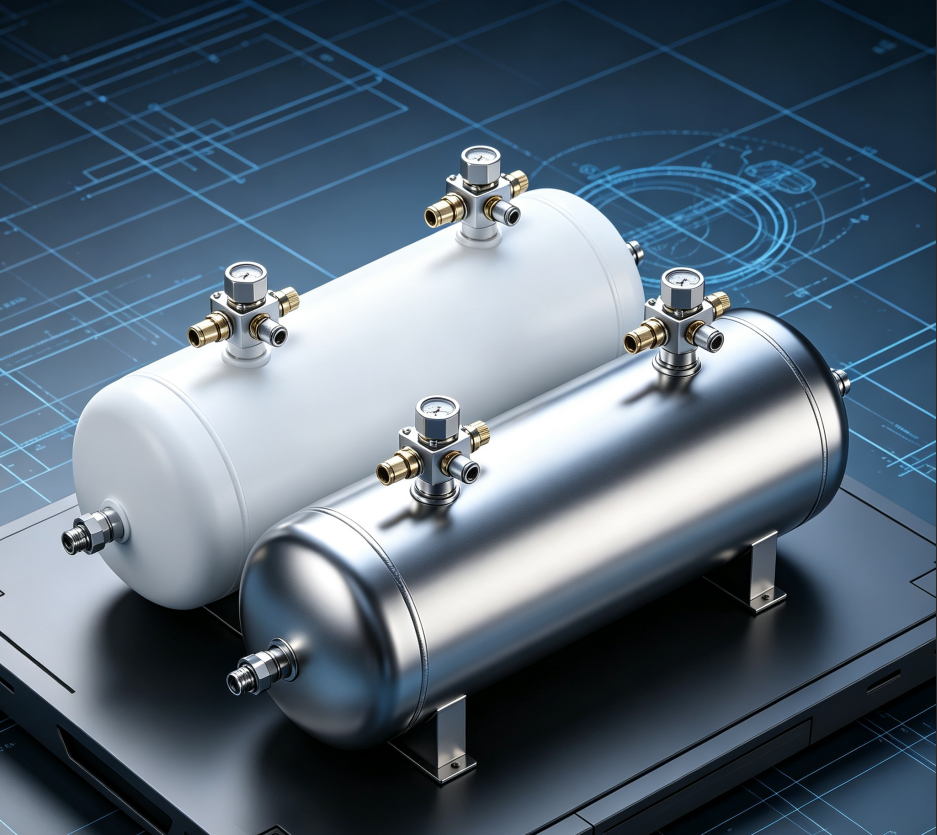
Carbon steel air tanks are cost‑effective for ordinary packaging workshops with standard compressed‑air drying treatment. Reliable surface blasting and anti‑corrosion coating are required. Automatic drain valve must be installed to avoid internal corrosion caused by condensate.
Stainless‑steel (304 /316L) air tanks are recommended for food‑grade, pharmaceutical‑packaging, high‑humidity or dust‑heavy workshops. Smooth inner surface reduces condensate adhesion, avoids rust particles mixing into air flow, and protects food‑contact packaging materials from contamination. Higher initial cost brings long‑term stability for hygienic‑standard production lines.
6. Practical Installation & Auxiliary‑Component Advice
Reasonable installation and supporting accessories maximize tank performance for packaging lines.
For multi‑unit packaging production lines, consider distributed auxiliary tanks close to high‑consumption stations, instead of relying entirely on one central large tank, to reduce pipeline pressure loss.
Mount automatic drain valve at the tank bottom to discharge condensate continuously, avoid manual‑drain omission.
Equip qualified safety valve and pressure gauge, keep easy‑to‑access position for observation and maintenance.
Arrange pipeline layout to avoid excessive long and thin pipelines between tank and packaging machines.
7.Routine Checks to Keep Packaging Lines Running Continuously
Even well‑matched air tanks need simple regular inspection to prevent unexpected packaging‑line downtime.
Check drain device working status regularly to prevent condensate accumulation inside tank.
Weekly inspection for leakage on welds, thread ports and connecting pipelines.
Monitor pressure gauge reading, prohibit over‑pressure operation.
Check tank surface for corrosion, focus on welding seams and head transition zone.
Carry out periodic inspection and hydrostatic test in accordance with local pressure‑vessel regulatory requirements.
Table of Contents
- 1. Pneumatic System Characteristics of Automatic Packaging Equipment
- 2. Why Air Receiver Tanks Matter for Packaging Production Lines
- Core Selection Criteria for Packaging‑Machine Air Tanks
- 4. Common Mistakes When Specifying Tanks for Packaging Lines
- 5. Material Choice: Carbon Steel vs Stainless Steel for Packaging Workshops
- 6. Practical Installation & Auxiliary‑Component Advice
- 7.Routine Checks to Keep Packaging Lines Running Continuously

